Wednesday, 27 October 2010

SUNDAY'S CHILD - FILM SYNOPSIS

Sundays Child

Waltonbury, a small and secluded rural village on the outskirts of Hertfordshire, has always been recognised for its close knit community where everybody knew everyone and secrets were unheard of.

That is until the first child went missing…

She’s young. She’s beautiful. Her corpse, laid bare in the bypass betrays no secrets, that is except for strange numbers seared onto the inside of her cold lifeless hand.

The first body was a warning.

When Molly, a teenage girl living in the village discovers that her sister goes missing, terror spreads through the isolated town. Molly begins to fear that a brutal serial killer is stalking the village streets; a shadowy madman without mercy or apparent motive. How could this be happening in a place so serene?

The final body…might be hers.

With the death toll rising, Molly races to expose a deadly conspiracy and the sadistic killer at its heart, and every move she makes could be her last.

Tuesday, 26 October 2010

Film Institution


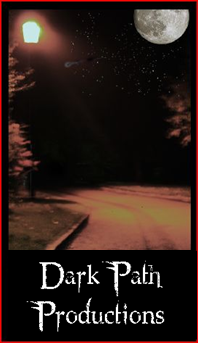
The image that we took ourselves was taken at nigh time. We timed this shot for the dark effect, as it ties in with the horror theme. It also ties in literally with the name; ‘Dark Path Productions’.
Our aim was to collect a few shots on the camera, preferably a long shot of a narrow road along with a street lamp.
With Lewis taking the shot on a high quality SLR camera and myself directing him we were able to collect the shot we aimed for.

In this image we can see:
  • 'Dark Path Productions' - font style=Northwood High
  • An over exaggerated moon,
  • A clear nights sky with shining stars,
  • An animated shooting star/ Flying comet,
  • A path/ road going into the darkness,
  • A shining street lamp revealing the path/ road curve into the distance, and
  • Trees on both sides of the road.


The moon has a good presence to the logo, as it is a very large object that obits earth, it has only been explored by few people and has much more to show then what we already know. The fact that it is a full moon adds superstition. All these facts alone denotes the personality of the Production Company; mysterious and superstitious, linking to the horror genre.

The clear night sky lets us view the over sized moon, as well the shooting star. The clear sky suggests a clear successful journey for the production company.


A shooting star is a special sight, as it is rare to see due to covering clouds and unpredictability. When a shooting star appears people praise it, like it is a pleasure to see. These facts all boost the reputation of the production company, as a special figure within the filming industry.


Below all the fantasy features is a path, lit up first by a street lamp, but then travels alone into the distance. This has a literal connection towards the name and a connection to the typical narrative structure of a horror. From the characters point of view the light symbolizes the equilibrium, but then after that comes the inevitable disruption. After the disruption comes the recognition, where another light source shines the path. After the recognition it is the protagonists responsibility to chose the right path to get to that final street lamp. The character may use sense and look up for answers, where the stars may direct the character to that happy ending. A risky decision that is rarely completed by the protagonist in horror movies.


The trees are either side along the path, which suggests that character that takes this journey can't be escaped from, as the arms of the trees are keeping the character within the path.

The dark scheme is an aspect of 'Pathetic Fallacy' where the human emotions are effected by the visual appearance of nature. The dark night adds superstition and cautions of what maybe ahead.

The name 'Dark Path Productions' is a recognisable name, as Alliteration is used.

Target Audience Profile

From my individual analysis of the group questionnaire conducted recently, I can now come to the conclusion of the films target audience. The film ideally needs a target audience of a certain size to make profit, as most films set out to do.
The first characteristic of the target audience is age; which in this scenario is between 15-25. The film may also appeal to others outside the age bracket as there is always that chance. This broad age group is categorized in my opinion as young adults, who go to the cinema for the social aspect, whether it be with school, college, university or work colleagues. The 'mode' age group we gave the questionnaires out to were 14-17. Using their views on the advertisement products we will know more what to incorporate into the finished products, and later evaluate why we did that. The choice's we decide will be chosen because they will either relate with the typical codes and conventions of the genre horror, ironical, link to a certain theme, and through the narrative.

The gender will be targeted at males and females. The responses we had from the questionnaire research shows that both genders are as interested as each other in horror films.
Social class is not a criteria to consider when discussing target audience, as everyone who has an income can afford to go to the cinema once a month or so, due to our statistics.
Other aspects of representation of characteristics that also are irrelevant are ethnicity and regional identity.

Wednesday, 20 October 2010

What I do when analysing an extract!!

CAMERA-


Camera shot is the amount of space that is seen in one shot or frame. Camera shots are used to demonstrate different aspects of a film's setting, characters and themes. As a result, camera shots are very important in shaping meaning in a film. Reviewing the examples on the right hand side of this page should make the different camera shots clearer.

Shot Types:
  • An extreme long shot contains a large amount of landscape. It is often used at the beginning of a scene or a film to establish general location (setting). This is also known as an establishing shot.
  • A long shot contains landscape but gives the viewer a more specific idea of setting. A long shot may show the viewers the building where the action will take place.
  • A full shot contains a complete view of the characters. From this shot, viewers can take in the costumes of characters and may also help to demonstrate the relationships between characters. For more information on costumes and acting refer to Chapter 4.
  • A mid contains the characters or a character from the waist up. From this shot, viewers can see the characters' faces more clearly as well as their interaction with other characters. This is also known as a social shot
  • A close-up contains just one character's face. This enables viewers to understand the actor's emotions and also allows them to feel empathy for the character. This is also known as a personal shot.
  • An extreme close-up contains one part of a character's face or other object. This technique is quite common in horror films, particularly the example above. This type of shot creates an intense mood and provides interaction between the audience and the viewer
Angles:
  • A bird's eye angle is an angle that looks directly down upon a scene. This angle is often used as an establishing angle, along with an extreme long shot, to establish setting.
  • A high angle is a camera angle that looks down upon a subject. A character shot with a high angle will look vulnerable or small. These angles are often used to demonstrate to the audience a perspective of a particular character. The example above demonstrates to us the perspective or point of view of a vampire. As a viewer we can understand that the vampire feels powerful.
  • An eye-level puts the audience on an equal footing with the character/s. This is the most commonly used angle in most films as it allows the viewers to feel comfortable with the characters.
  • A low angle is a camera angle that looks up at a character. This is the opposite of a high angle and makes a character look more powerful. This can make the audience feel vulnerable and small by looking up at the character. This can help the responder feel empathy if they are viewing the frame from another character's point of view.
Movements:
  • A crane is often used by composers of films to signify the end of a film or scene. The effect is achieved by the camera being put on a crane that can move upwards.
  • A tracking shot and a dolly shot have the same effect. A tracking shot moves on tracks and a dolly shot is mounted on a trolley to achieve the effect in the example above. This camera movement is used in a number of ways but is most commonly used to explore a room such as a restaurant. By using a tracking shot or a dolly shot the composer of a film gives the viewer a detailed tour of a situation. It can also be used to follow a character.
  • Panning is used to give the viewer a panoramic view of a set or setting. This can be used to establish a scene


EDITING-
  • A Straight cut break from one shot to the next. Cuts carry the
    continuity of action forward in a straightforward manner, from action to action or place to place.
  • Jump cuts are confusing cuts from one shot to the next that do not
    follow the obvious rules of cause and effect. These cuts are usually used to disrupt the
    audience’s attention in order to create shock.
  • Fade outs show the screen fade from an image to a black screen.
  • Fade ins show the screen fade from black to an image. Both fade-ups
    and fade-downs are used to suggest the passage of time and generally work to give
    the audience a chance to take a breath in preparation for the next scene.
  • Dissolves edits show one image slowly disappear as a new image is
    introduced. Dissolves are used to indicate the end of one event and the beginning of
    a new event or scene.
  • A Wipe edit is used to show one part of the screen literally wipe over the rest of the
    screen. One image disappears as it is replaced by a new image. This kind of edit
    is not often seen in movies, largely because it looks comic-bookish.
SOUND-


Diegetic Sound- Sound whose source is visible on the screen or whose source is implied to be present by the action of the film:
  • voices of characters
  • sounds made by objects in the story
  • music represented as coming from instruments in the story space ( = source music)
Diegetic sound is any sound presented as originated from source within the film's world


Diegetic sound can be either on screen or off screen depending on whatever its source is within the frame or outside the frame.


Non-Diegetic- Sound whose source is neither visible on the screen and has not been implied to be present in the action:
  • narrator's commentary
  • sound effects which is added for the dramatic effect
  • mood music
Non-diegetic sound is represented as coming from the a source outside story space.

MISE EN SCENE-

French for - PUT IN THE FRAME'
Lighting-

The intensity, direction, and quality of lighting have an effect on the way an image is perceived. Light and shade can emphasise texture, shape, distance, mood, time of day or night, season, glamour and it affects the way colors are rendered.

Types of lighting:
  • Low Key
  • High Key
  • Under lighting
  • Top lighting
  • Back lighting

Colour and Connotations-

  • Red - Energy, war, danger, strength, power, determination as well as passion, desire, and love.
  • Pink - Signifies romance, love, and friendship. It denotes feminine qualities and passiveness.
  • Brown - Suggests stability and denotes masculine qualities.
  • Orange - Combines the energy of red and the happiness of yellow. It is associated with joy, sunshine, and the tropics.
  • Gold - Evokes the feeling of prestige. The meaning of gold is illumination, wisdom, and wealth.
  • Yellow - Is the color of sunshine. It's associated with joy, happiness, intellect, and energy.
  • Green - Is the color of nature. It symbolizes growth, harmony, freshness, and fertility.
  • Blue - Is the color of the sky and sea. It is often associated with depth and stability. It symbolizes trust, loyalty, wisdom, confidence, intelligence, faith, truth, and heaven.
  • Purple - Combines the stability of blue and the energy of red. Purple is associated with royalty.
  • White - Is associated with light, goodness, innocence, purity, and virginity.
  • Black - Is associated with power, elegance, formality, death, evil, and mystery.


Props-
Objects make up the scene, and when creating a set the director must decide on the Props, as each prop can hold a connotation.


For example:

  • A gun- Suggests Violence, Anger and Pain.
  • A rose- Suggest Love, Passion and Romance.
  • A Football- Suggests Fair play, Respect and activeness.
  • A Baseball bat- Suggest Protection, Anger and Violence.
Hair and Make-up-
The style and Colour of hair builds a personality of a Character.

Men- Style:
  • Short= A clean, professional and well looked after person.
  • Long= Lazy and Doesn't pay attention to looks.

Woman- Style:


  • Short= Masculine and Modern.
  • Long= Traditional and feminine.
  • Straight= Pure and innocence.
  • Curly= Complicated and Busy.

Clothing-

This factor is important because it can build a strong suggestion of the character personality. Types of clothing can carry out different connotations. Sub-Cultures, Social class, Regional Identity, Ethnicity, Gender and Sexuality can create a characters representation, which can create an opinion for the audience, and can create an individual identity for each character.


  • Sub-Cultures- Chavs wear baggy and sporting clothes, Goths wear dark style clothing.
  • Social Class- Depends on the exspense of clothes. higher wear designer, middle wear casual clothes bought in regualar high street stores, and working wear second hand, damaged and old clothes.
  • Regonal Identity- People tend to wear clothes that are suitable for their living environment. People who live in the country and are into agreculture wear thick sway clothes, whereas in london and city's clothes can vary in style because there tends to be split of sub-cultures, and so clothes vary.
  • Ethnicity can be represented through traditional clothing that can be recognised easily, for example and Turban symbolises religion and a eastern descent.


Position within Frame

Selecting where to place the character is the directors job. Each character has a level of importance, and selecting where to put them in the cameras frame gives them a sense of identity, and makes things clear to the audience who are the main characters they are meant to focus on.

CLASSIFICATION

Film classification is a legislation that categorises films due to their content. The categories are age groups and limits under-age viewing because of potential emotional disturbances.

A film is judged upon a few issues, those being:
  • Language
  • Violence
  • Horror
  • Sex
  • Drugs
  • Nudity
  • Imitable technique
  • Tome
  • Discrimination/bigotry
  • Realism within fantasy
Universal
- It is impossible to predict what might upset any particular child. But a ‘U’ film should be suitable for audiences aged four years and over. ‘U’ films should be set within a positive moral framework and should offer reassuring counterbalances to any violence, threat or horror.

- If a work is particularly suitable for a pre-school child to view alone, this will be indicated in the Consumer Advice.

Parental Guidance
- General viewing, but some scenes may be unsuitable for young children.

-Unaccompanied children of any age may watch. A ‘PG’ film should not disturb a child aged around eight or older. However, parents are advised to consider whether the content may upset younger or more sensitive children.

12A and 12
- Exactly the same criteria are used to classify works at ‘12A’ and ‘12’. These categories are awarded where the material is suitable, in general, only for those aged 12 and over. Works classified at these categories may upset children under 12 or contain material which many parents will find unsuitable for them.

- The ‘12A’ category exists only for cinema films. No one younger than 12 may see a ‘12A’ film in a cinema unless accompanied by an adult, and films classified ‘12A’ are not recommended for a child below 12. An adult may take a younger child if, in their judgement, the film is suitable for that particular child. In such circumstances, responsibility for allowing a child under 12 to view lies with the accompanying adult.

- The ‘12’ category exists only for video works. No one younger than 12 may rent or buy a ‘12’ rated video work.

15
-No-one younger than 15 may see a ‘15’ film in a cinema. No-one younger than 15 may rent or buy a ‘15’ rated video work.

18
-No-one younger than 18 may see an ‘18’ film in a cinema. No-one younger than 18 may rent or buy an ‘18’ rated video work.

18R
-The ‘R18’ category is a special and legally restricted classification primarily for explicit works of consenting sex or strong fetish material involving adults. Films may only be shown to adults in specially licensed cinemas, and video works may be supplied to adults only in licensed sex shops. ‘R18’ videos may not be supplied by mail order.

Tuesday, 19 October 2010

STUDY OF NARRATIVE STRUCTURES

In our set Homework we were set the task to study the narrative structures of Horror Films. This would include writing about the narrative theory's conducted people in the past time, and analysing recent films and how they apply these concepts.


Toderov's Theory


Toderov's theory outlines 5 key stages to a basic storyline structure. Often renowned as the 'Classic' storyline as it's used in so many popular films.

1. Equilibrium introduced
2. Disruption of the Equilibrium
3. The Recognition of the Disruption
4. Attempt to repair Disruption
5. Reinstatement of the Equilibrium

http://www.writework.com/essay/media-writing-and-todorov-s-theory

Propp's Theory

This theory was developed by Vladmir Propp, based on the work of the Russian Formalists. Propp used Russian Folktales as the basis for his theory but it can be applied to all types of fiction as well as many movies.

7 Character types:


  1. The hero (seeks something)
  2. The villain (opposes the hero)
  3. The donor (helps the hero by providing a magic object)
  4. The dispatcher (sends the hero on his way)
  5. The false hero (falsely assuming the role of hero)
  6. The helper (gives support to the hero)
  7. The princess (the reward for the hero but also needs to be protected from the villain
  8. Her father
http://www.scribd.com/doc/8332774/Propps-theory-in-detail


To fully understand these theories I have analysed some thriller/horror films where I have outlined the Characters and their roles, along with a detailed analysis on the structure on the stories. Horror movies tend to not follow the Toderov's 5 stages chronologically because sometimes there is no happy endings. We can see from my analysis's that there are going to be more disruptions than anything else.

The Grudge

Disruption- The first scene we are shown is a couple in a multistory flat waking up in the morning. All of a sudden the man commits suicide by falling over the balcony to his death in the middle of the street.
Another scene draws us to a house where a young woman explores a house where she caring for a woman who has a disability. She hears noises. Seeking this noise she pops her head up through the attic door where she turns around until the haunting figure comes out of the darkness and kills her.

Equilibrium- Main Character Karen Davis (Sarah Michelle Gellar) is seen wake up in late in day. With her boyfriend they makes their way to work and splitting up during their journey in the busy city to each others jobs in the city.

Disruption- Karen goes to the house where the young girl disappeared and she covers her shift as she is missing, not knowing of the dangers. Karen explore the house until she is found by her boss in a tormented state.

Recognition - Karen is in hospital after a bad day at work. Questioned by the police they search for answers.

Disruption- Karen's boss and boyfriend are next to be perished by the haunting grudge.

Character role in The Grudge

  • KAREN - PROTAGONIST - VICTIM
  • DOUG - HELPER/DONOR - VICTIM
  • ALEX - KAREN'S BOSS - HELPER/ VICTIM
  • GRUDGE- VILLAIN
  • UNKNOWN SUICIDE MAN- VICTIM
  • YOKO - JAPANESE SOCIAL CARER- VICTIM

Saturday, 16 October 2010

Analysis of Questionnaire

We created a questionnaire as a group task to assess our target audience. The first part of the questionnaire will tell us more about the target audience, and so we can create a basic target audience profile. The second section tells us more about the target audience's preferences. Using the information gathered we can apply their wants into to finished product.


Q1.
We can see here we had more females answering our questionnaire than males. However 3% doesn't hinder the overall outcome by a large margin, so I think we can continue knowing that the answers my colleagues and I collected are valid and genuine. At the end of the day things could have ended up worse.


Q2.
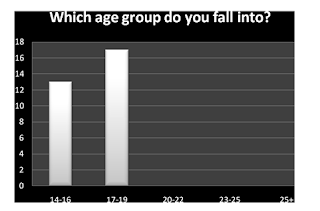
The bar chart informs us that our target audience for the media products are aged 14-19. This was the best range we could manage and foreshore it would have been nicer to have a larger age group to market our products to. The questionnaires results will therefore cater for the ages of between 14 and 19 years of age. Using the information we have gathered as a team we can plan and apply their thoughts to our group task and subsidiaries.


Q3.
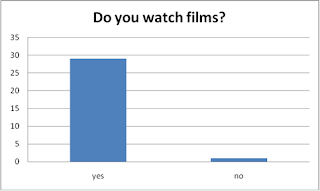
We needed to know whether our target audience watches films. A strong result informs us that the target audience is experienced in film watching and has the knowledge and understanding of what makes a good teaser trailer, poster and film website.


Q4.
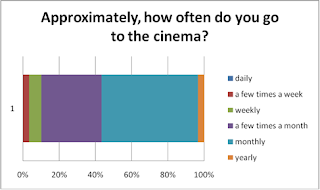
These results lets me know that our target audience is a regular cinema viewer.
The most popular choice is monthly, this tells me that people go to the for the big blockbusters that have been highly anticipated by the use of marketing campaigns that include teaser trailers, posters and Internet advertisements to reach the target audience.


Q5.
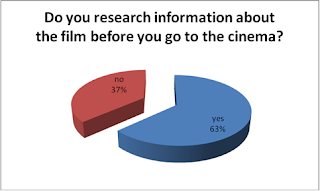
This directly informs us that the majority of the target audience researches a movie before paying to see it. A wise choice, but this also signifies that the target audience makes use of the products as part of the advertising campaign. So our products; both group and individual must appeal effectively to the target audience.


Q6.
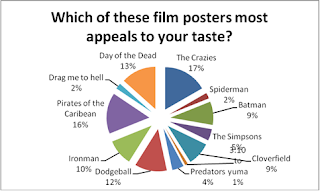
The Crazies, Day of the Dead and Pirates of the Caribbean are certainly the most aesthetically pleasing film posters to the target audience. Applying similar presentational devices will foreshore raise my chances of making a poster that appeals to the same target audience.


Q7.
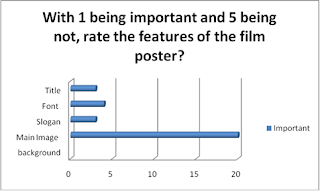
A huge portion of people voted that the main image should be the most important feature on the page. Due to the result I will manage my time effectively to produce an appealing main image, along with other features nonetheless.


Q8.
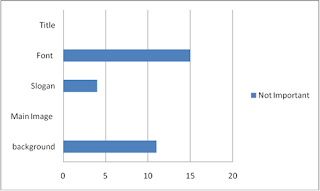
In this question we are trying to outline the unimportant features that appear on a film poster.
For the least important figure to appear on a film poster 2 features where opted as the least, those being the font and the background.


Q9.
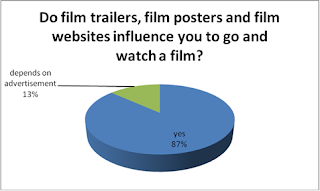
In conjunction with question 5 we can say that the 3 forms of advertising I will be creating are vitally important to persuade the target audience to view it in the cinema. No one disagreed that they aren't important, and so it will influence the group and myself to create top-notch advertising products.


Q10.
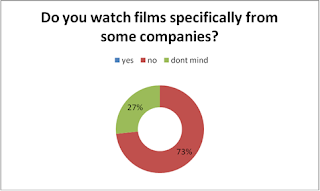
This question will tell me if the target audience judges the film depending on the institution behind it all. The results clearly shows in my favour, as the institution is not an important part in our production piece. However this isn't stopping me from designing our logo whilst considering the concepts adapted by the big institutes.


Q11.
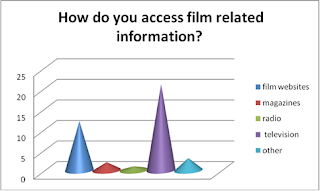
The question I am asking informs me how the target audience accesses the film related information. With no surprise the television is the powerful in response, whilst the website is the second most popular in response, as the internet is the fastest form of media to pass our generation. This answer also tells me that my website is just as important to complete as an advertisement product that appeals to the target audience.


Q12. Who is your favourite actor/actress?

Most popular answers:

· Christian Bale

· Will Smith

· Johnny Depp

· Leonardo Dicaprio

A high majority of these actors/actresses appear in horror films. Johnny Depp for example stars in Sweeny Todd, Sleepy Hollow etc... Studying the previous films staring these actors I could gain an understanding of what the target audience and figure out any devices used.


Q13.
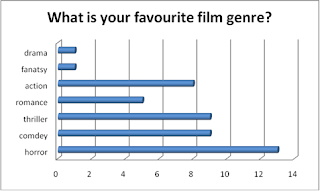
The questionnaire informs us that horror is by far is the most popular film genre. This reassures us that our chosen genre is popular and the target audience is of much relevance. Prior to this questionnaire the group members and my favourite film genre was horror, and we felt that we would be comfortable in producing an advertising campaign based upon the genre.


Q14. From your favourite genre, what would you want to feel from watching the film?

Most popular answers:

· Excitement

· suspense

· happy

· satisfied

· entranced

· Scared

· Emotional

· Laughter

· confused

· Fear

· Loved

· surprised

I mixed response I feel because its either a happy or a scared emotion they want to experience. both don't mix, and so I would have to make the decision that the target audience should fell scared whilst viewing our product, as thats what horror films do!


Q15.
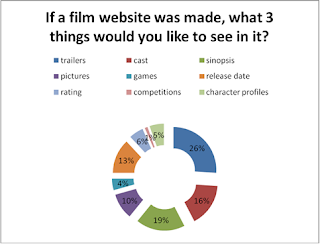
This question will give a good understand of what the website should include. Nevertheless, with a website it is virtually possible to include any of these features, but there are some features that are out of our reach due to the technical side; this statement referring to games.
The results stated that the target audience would want to see a trailer/ preview, cast list and synopsis.
I think they would prefer to see these features because they want to find lots of information about the film before attending the cinema, to determine whether it is worth seeing.


Q16.
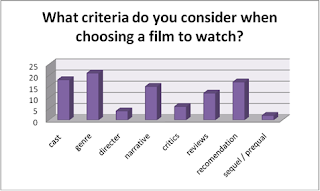
The results of this question not so clearly outlines that genre, cast, recommendations and narrative are the most important criteria for the target audience when choosing a film. The cast that we will be managing will be experienced in drama studies, and with our non-existent budget the actors/actresses will not be known. The narrative is down to our creativity as a group to make a successful storyline that interests the viewer.


Q17.
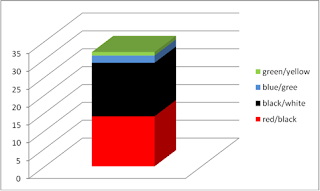
This Question asks what colour scheme they like the most. With red/black and black/white proving to be popular it fits in with the horror genre.


Questions 18-23 asks the target audience to clearly outline their opinion on what's important and what's not. With 1 being most important and 5 being least, the target audience gave their thoughts in numerical rating. The least important response we got was about the inclusion of the main character on the poster, whilst all other responses suggested that everything else was an important feature in work on.


Q18


Q19


Q20


Q21


Q22


Q23

Our Questionnaire...

This questionnaire is the final version created by our group. Through the research we are going to undertake we can give an overview of our target audience and what they want to see in a conclusion. This piece is of research is by far the most important as it is our only joint primary research method/technique used. It is our chance to find for ourselves what our target audience really wants, and so this questionnaire must be checked thoroughly and devised appropriately to ask those questions.